A food conveyor belt rarely fails because of one factor. Service life comes from the match between belt material, conveyor geometry, loading, sanitation, and daily setup. A premium belt can wear out early on undersized pulleys, against a frame, beyond its heat rating, or under the wrong cleaner. A simpler belt may last longer on a well-set line. That is why a useful life estimate starts with operating data, not a broad label such as “food grade.”
For buyers, the concern is not only how many months the belt will run. You also need stable hygiene, predictable cleaning time, fewer emergency stops, and a sound splice. The points below show what you should verify before approving a specification.
Why Is Belt Material Only the Starting Point?
The same material can give very different results on two food lines. Oil, moisture, temperature, cutting, release, and cleaning all change the duty. Start with the process, then compare food-processing belt options.
Match the Material to the Product
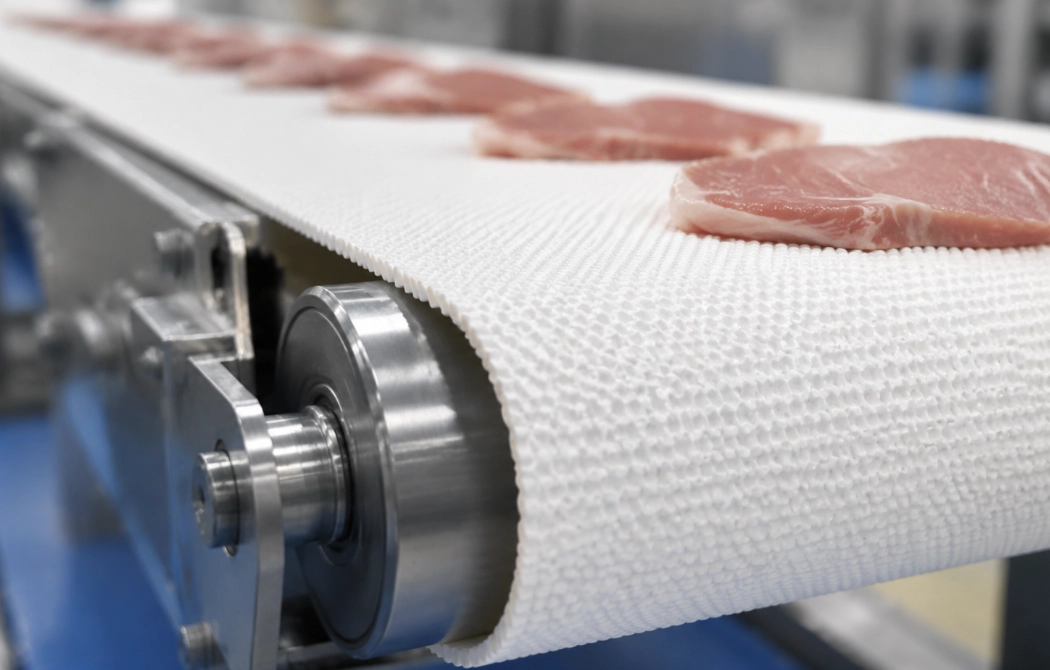
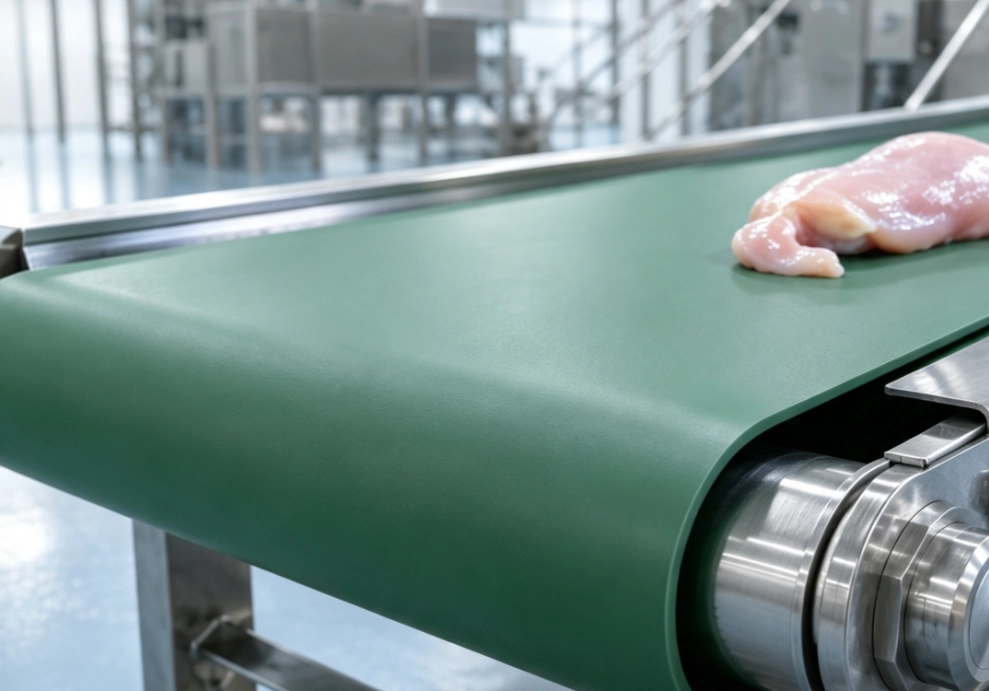
TPU and TPE homogeneous belts use a one-piece, fabric-free structure. They avoid textile layers that may absorb liquid through an open edge and remove a common delamination risk. This is useful on raw meat, seafood, dairy, frozen food, and other wet lines.
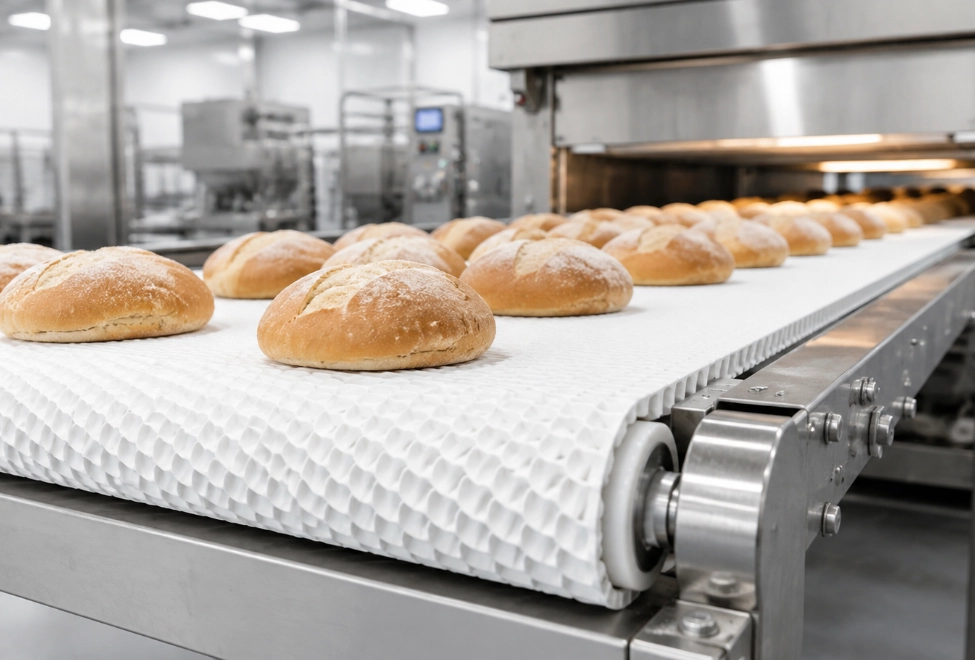
It is not the answer for every machine. A bakery transfer may need gentle release, a cutting station may need more cut resistance, and a fried-food line needs stability around fat and heat. Choose from actual contact conditions, not the industry name alone.
Choose the Construction before the Surface Pattern
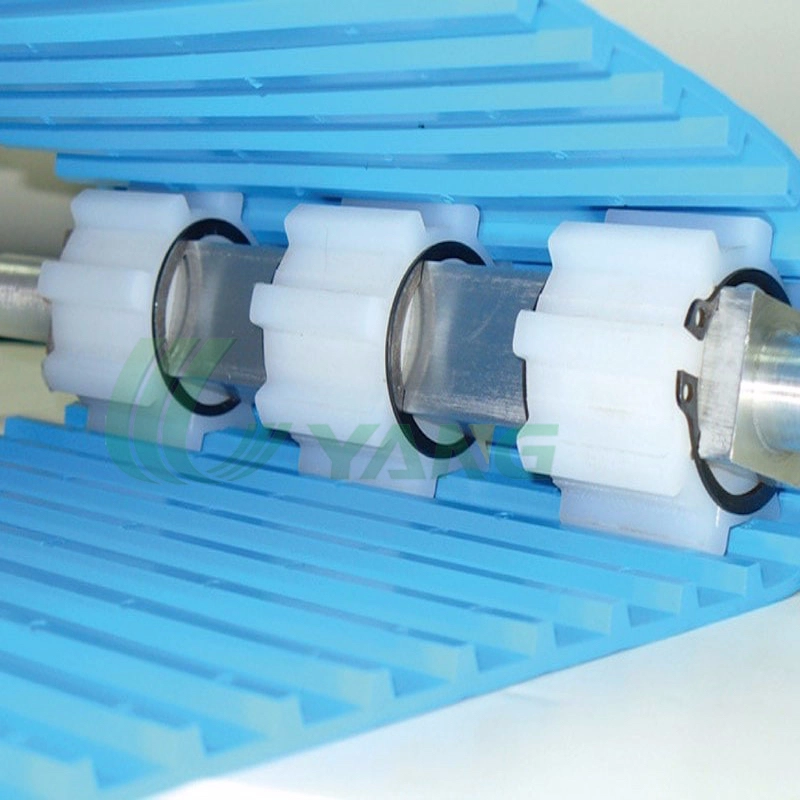
Check whether the belt is homogeneous or fabric-reinforced, friction-driven or positively driven, and whether its edges can be sealed. Then choose a surface that gives enough release or grip without making sanitation harder. A poor joint or damaged edge can become the first failure point.
How Do Conveyor Geometry and Setup Change Belt Life?
A belt bends around pulleys, carries tension, and crosses support points. Small setup errors repeat thousands of times per shift, so mechanical details often decide service life.
Respect the Minimum Pulley Diameter
If a pulley is smaller than the listed minimum, bending stress rises near the joint, underside, and edges. Check drive, tail, nose-bar, and return pulleys. One undersized roller can undo a careful selection.
Set Only the Tension the Drive Needs
More tension is not a safety margin. It loads the splice, bearings, shafts, and edges. On a positive-drive belt, tooth engagement and pulley alignment matter more than tightness. Repeated take-up adjustment can hide a dirty pulley, seized roller, or poor tracking.
Keep the Belt Away from Fixed Metal
An edge that touches the same guide or frame section can be cut deeper each day. Causes include uneven rollers, product buildup, a crooked splice, or guides set too close. A polished mark on one edge is already useful evidence. Do not wait for a tear.
Control Transfers and Product Impact
Sharp bones, frozen blocks, hard packaging, and dropped product can damage a correctly selected belt. Scrapers also cause trouble when they are too stiff or badly angled. Reduce drop height and remove sharp contact points at the infeed and discharge.
Why Can Sanitation Shorten a Good Belt’s Life?
Cleaning protects food safety, but it can be the hardest part of the belt’s day. Hot water, detergent, sanitizer, pressure, and rapid temperature change all matter. The cleaning plan must suit the material and residue.
Control Temperature, Chemistry, and Contact Time
Use the cleaner at the concentration, temperature, and contact time approved for the belt. Stronger chemical or hotter water is not automatically better. Excess alkali, acid, chlorine, heat, or dwell time can cause swelling, hardening, cracks, or loss of splice strength. Good rinsing matters, especially on the return side.
Clean without Adding Mechanical Damage
Homogeneous belting can reduce trapped residue and cleaning work. Sealed edges and a welded joint remove common water entry points. Still, close-range pressure washing, metal scrapers, and sharp tools can score the surface. Blue belting helps workers spot fragments, but does not replace inspection.
What Should You Check before Approving a Belt?
A supplier cannot judge service life from width, color, and thickness alone. A selection sheet should describe the food, conveyor, sanitation method, and production target. A little more time at quotation stage is usually time well spent.
Use Real Operating Data
Provide these points before asking for a final recommendation:
- Food type, size, temperature, oil or moisture level
- Direct-contact or packaged-product duty
- Belt width, endless length, speed, incline, and running hours
- Product load and impact at the infeed
- Drive type, pulley diameters, and available take-up
- Required cleats, guides, sidewalls, perforations, or sealed edges
- Detergent, sanitizer, water temperature, pressure, and cleaning frequency
- Failure photos, splice details, and a short running video
The conveyor belt product range includes several structures because wet meat, dough, and frozen-food lines do not ask a belt to do the same job.
Read Product Limits as One System
The Easy-to-Clean Positive Drive Homogeneous Belt-K 25 Series shows why every value must stay tied to the exact belt code. Listed variants use TPU in 2.3 or 2.8 mm thickness with a 25.4 mm pitch. Depending on the code, the published maximum load is 80 or 210 kg/m², the working temperature is -5 to +80°C or -20 to +60°C, and the minimum roll diameter is 63.6 or 79.5 mm.
Do not take the highest number from each column and treat those values as one belt. Hardness, thickness, load, temperature range, and pulley diameter belong to a specific variant. That small data-sheet detail makes a large difference on the machine.
Confirm the Splice and Edge Plan
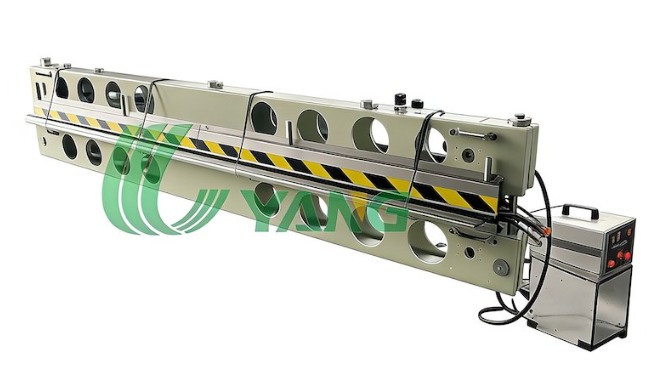
Ask how the endless joint will be made, which welding material will be used, and whether the edge treatment matches the sanitation zone. For a thermoplastic homogeneous belt, the splice material and welding settings must be compatible. Added guides, cleats, or sidewalls should also match the pulley path and cleaning access.
How Can Routine Checks Add Useful Life?
Maintenance works best when it finds the first sign of a problem. Most checks fit into existing cleaning or changeover time. Consistency matters more than a long inspection after a stoppage.
Check the Same Points at a Fixed Interval
During routine cleaning, inspect the splice, edges, underside, drive teeth, guides, and contact surface. Confirm that rollers turn freely and residue is not lifting the belt. During planned maintenance, check pulley alignment, tracking, tension, scraper pressure, support gaps, and bearings.
Correct the Cause before Repairing the Belt
If an edge keeps fraying, correct the contact or tracking problem before fitting another belt. If a splice opens repeatedly, review pulley diameter, alignment, welding temperature, pressure, and cooling. Repairing visible damage without removing the cause buys time, not service life.
Keep a Simple Belt Record
Record the installation date, belt code, splice method, cleaning changes, adjustments, repairs, and replacement reason. It sounds basic, but the log often links failures to a new sanitizer, speed increase, or guide adjustment.
How Can UYANG BELTING Support a Longer Service Life?
UYANG BELTING supplies PVC, PU, homogeneous, solid-woven, patterned belts, accessories, and processing equipment. Its company profile states more than 20 years of manufacturing experience, an 80,000-square-meter site, and 15 conveyor belt production lines. The broad range allows different structures to be compared for each food application.
Send the operating data with clear photos and a running video. UYANG BELTING can review material, drive method, pulley match, surface, splice, and edges before production. Its stated policy includes a 12-month quality guarantee under normal conditions from the Bill of Lading date, plus lifetime technical support.
FAQ
Q1: How Long Should a Food Conveyor Belt Last?
A: There is no reliable fixed number of months for every line. Life depends on the belt code, food contact, load, speed, pulley size, tension, tracking, sanitation, and splice quality.
Q2: Is a Thicker Belt Always More Durable?
A: No. Extra thickness may help against cutting or impact, but it can need a larger pulley and more bending force. A thinner belt with the right material and pulley match may last longer.
Q3: Does a Homogeneous Belt Always Last Longer Than a Fabric Belt?
A: Not automatically. Homogeneous belting helps where liquid ingress, frayed edges, or delamination causes trouble. Fabric-reinforced PU or PVC may suit lighter or differently driven duties.
Q4: What Is the Most Common Cause of Early Belt Failure?
A: Early failure usually comes from a mismatch. Over-tension, poor tracking, small pulleys, harsh cleaning, frame contact, and a weak splice are common findings.
Q5: What Information Should You Send before Ordering?
A: Send the product, temperature, oil and moisture level, load, speed, belt dimensions, drive type, pulley diameters, cleaning method, required profiles, failure photos, and a short video. UYANG BELTING can then match the exact belt code and fabrication plan to the line.