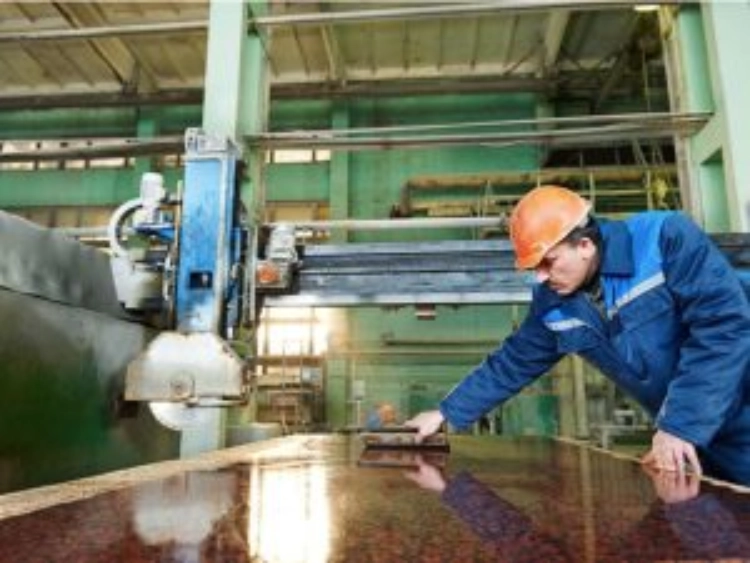
What decides a belt on a marble or ceramic line? Not the polymer on the cover. Wet slurry decides it, and slurry is stone dust held in water that dries into a grinding compound. So check the return side first. Then the face that sheds water. Then the edges. Argue about polymer last. Work in that order and the belt wears out evenly, at an age you can plan for. Skip it and you get the belt below.
Fourteen months on a polishing line. The buyer was pleased with that belt, right up until someone flipped it over and put a gauge on the backing. Half the thickness gone.
The top looked fine. That is the trouble with stone processing.
Look at the Return Side
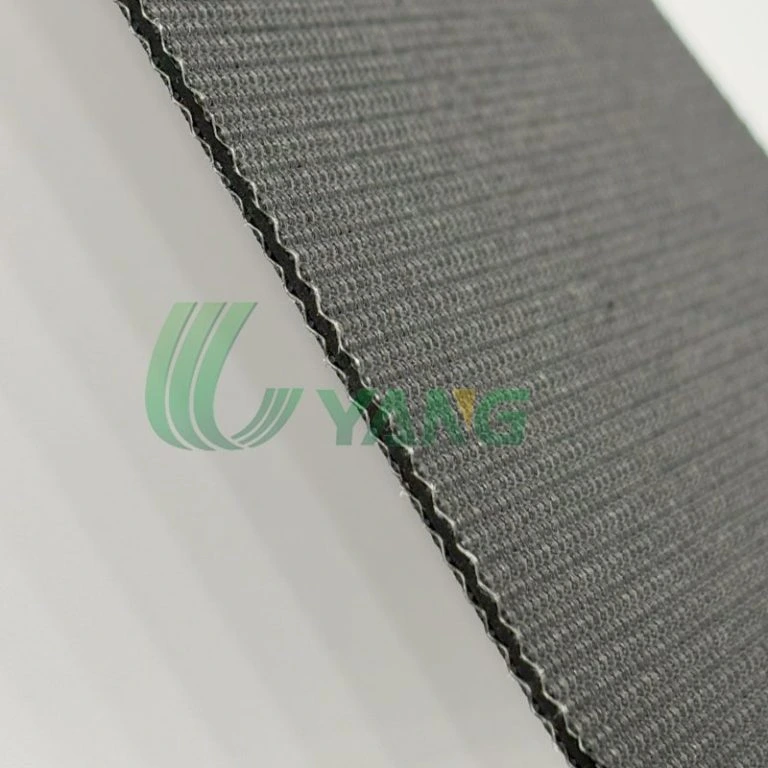
Dry stone dust does little harm. Wet it and you have a grinding compound. On a wet line that compound goes to the face nobody photographs.
So go and look at your return side. Properly. Grit packed into the backing. A shiny stripe where the slider bed has polished it. An edge gone soft where the frame touches. None of that shows from where the production manager stands. Which is why the next belt gets ordered on price as well.
One torch. One gauge. Five minutes a month. Nothing in the plant is cheaper to check. The reading also settles what to buy next. Backing still measures to spec? Wear is not your problem yet, so the money belongs on tracking and clean pulleys. Thin anywhere? Order against the wet conditions the belt actually meets, not against last time’s price.
Water Is the Delivery System
Water pushes grit into corners a lance never reaches. Then it holds it there. It also hunts for a way in. A cut edge. A splice somebody nicked. A slab corner that caught the belt last Tuesday. A splice, for the record, is the welded joint where two belt ends meet. Once the fabric is wet it stays wet. The join starts to lift.
By then it looks like a splice failure
It isn’t. It is an edge that has been drinking for a month.
Three Decisions, Three Distractions
Buyers spend a fortnight on polymer choice and five minutes on drainage. On a wet line that is the wrong way round.
Drainage first
Patterns that shed water beat patterns that hold it. Grooves. Open weaves. Anything that stops a film forming. Standing water on an incline lets the slab travel too, Ask the operator who watched a polishing head cut fresh air for a shift.
Grip second
Compound, then pattern. If more tension is the answer, the question was wrong. Tension stretches belts. It loads bearings. It invents its own tracking faults. It cannot manufacture friction.
Edge third
Sealed edges, with the edge and guide options priced before the order goes in. Width tolerance checked on arrival. Assume nothing. A frayed edge on a wet line is an open pipe into the fabric.
Then the distractions: brand name, cover thickness on its own, colour. A glazed thick cover grips worse than a textured thin one. Colour on stone is decoration.
| Decision order | Question to settle | Why it sits here |
| 1. Drainage | Does the surface shed water or hold a film? | Standing water carries grit and lets slabs travel on inclines |
| 2. Grip | Does the pattern hold the slab at your incline and weight? | Tension is not a substitute; it stretches belts and loads bearings |
| 3. Edge | Is the edge sealed, and is it priced before the order? | A frayed edge on a wet line is an open pipe into the fabric |
| 4. Polymer | PVC or PU at this station? | Chemistry is decided last, once water and edges are handled |
Stations Don’t Share a Belt
Stone plants buy one spec for everything. Then packing ends up with a belt it never needed. Polishing gets one that keeps sliding.
Wet saw discharge
Water, chips, slab corners. Thick cover, fast drainage, an edge that takes a knock without opening up.
Polishing
Grip, and nothing else comes close. One shifted slab and twenty minutes of grinding goes in the skip.
Inspection
Smooth, light, clean at the edges. A PU belt suits this station better than an abrasion cover, and costs less to run. PU means polyurethane here: a thermoplastic cover that resists oil and swelling, and wipes down smooth.
Packing
Dry, flat and cheap. Nothing on a packing bench needs abrasion resistance.
Patterns: Stop Guessing
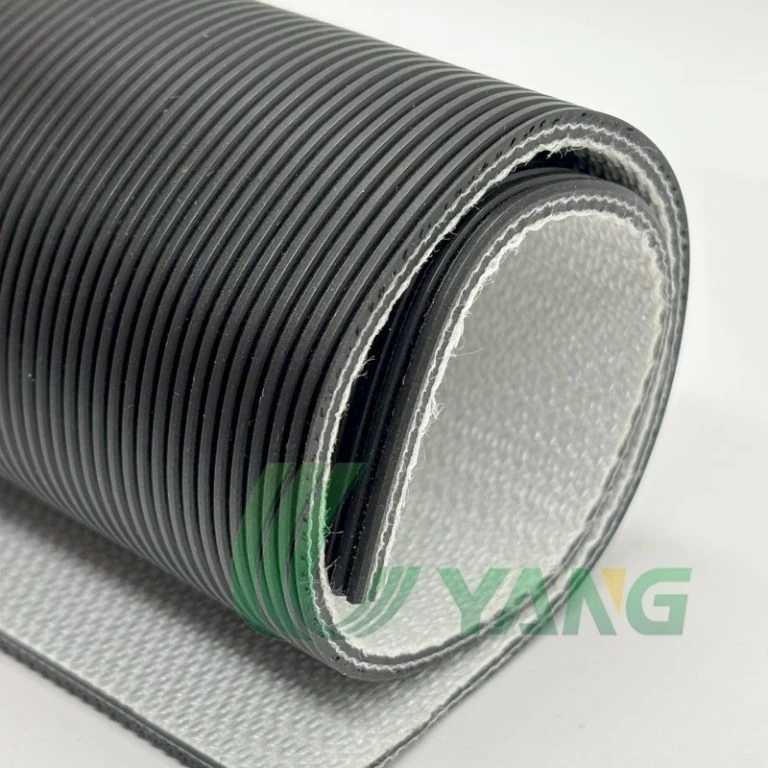
Plain sheds product cleanly. It also slides worst. Shallow texture holds a slab on an incline and leaves no mark. Deep grooves drain fast. They keep grit too, if the wash-down crew had a bad week. Ribs help on long centres. Until the frame goes out of square. Frames do go out of square.
Ask what a pattern does wet, loaded, at your slab weight. “Anti-slip” is a label. A pattern picked from a photograph is a pattern picked at random.
Check the Pulleys Before the Belt
A ridge of dried slurry on a pulley steers a belt exactly like a bent frame does. One costs an hour. The other costs a purchase order. Clean the drums. Track with the load running. Check edge clearance at both ends. Stone lines are long, so an error at the head arrives as contact at the tail.
Send This, Get a Real Quote
Station. Slab weight. Water. Slurry chemistry. Incline. Pulley diameters. Splice type. Edge treatment. Spare with the first order, yes or no.
That list gets a quote you can compare. “Conveyor belt for ceramic” gets a price list and a belt chosen by guesswork.
Splicing catches people out too. A water-cooled press heats for roughly twenty minutes and cools for two, so a joint takes 25 to 30 minutes in the workshop. Air-cooled all-in-one heats in 4.5 minutes and finishes in 9 to 12. Put those two numbers side by side and you see why the air-cooled unit goes to the line, instead of the belt coming to it.
About UYANG BELTING
Tianjin UYANG BELTING. Twenty years of light conveyor belts. 80,000 square metres, fifteen production lines, PVC, PU and PVK. Marble and ceramic processing is one of the named industries there. Widths cut to order, guides and sidewalls welded in house, endless splices finished before dispatch.
Send a line drawing and the belt list comes back against it: contact the team. Standard orders leave in seven to twenty days. Warranty runs twelve months from the bill of lading.
Buy for the Stops
Belts in a stone plant wear out. Budget for it. Cheap per metre rarely means cheap per year. The gap turns up in stops, not in invoices.
Monthly return-side check. Drainage before grip. Sealed edges on every wet line. One spec per station, not one per plant. None of it adds to the price per metre.
FAQ
Q1: PVC or PU on a wet ceramic line?
A1: PVC where the chemistry is mild and money is tight. PU where oil, solvent or hard abrasion turn up. On a wet line the edge treatment matters more than the polymer. Most quotes skip it.
Q2: Why does the belt keep running off?
A2: Frame first, then pulleys, then grit. Then edge wear. Tension hides the cause and eats belt life while it hides.
Q3: Is a textured surface needed?
A3: Only where the product slides. Texture on a flat run traps slurry and doubles the cleaning job.
Q4: How often should stone belts be replaced?
A4: Measure the backing monthly. Replace when it has measurably gone, not when the calendar says so.
Q5: Is on-site splicing possible?
A5: With a press and a square cut, yes. Air-cooled units travel better. Practise on an offcut before the night the line is down.