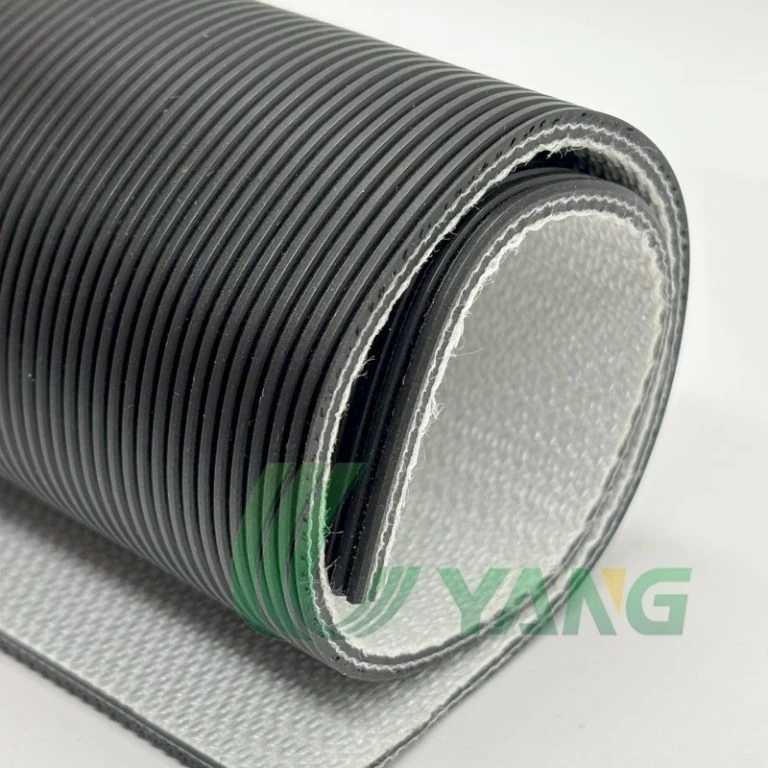
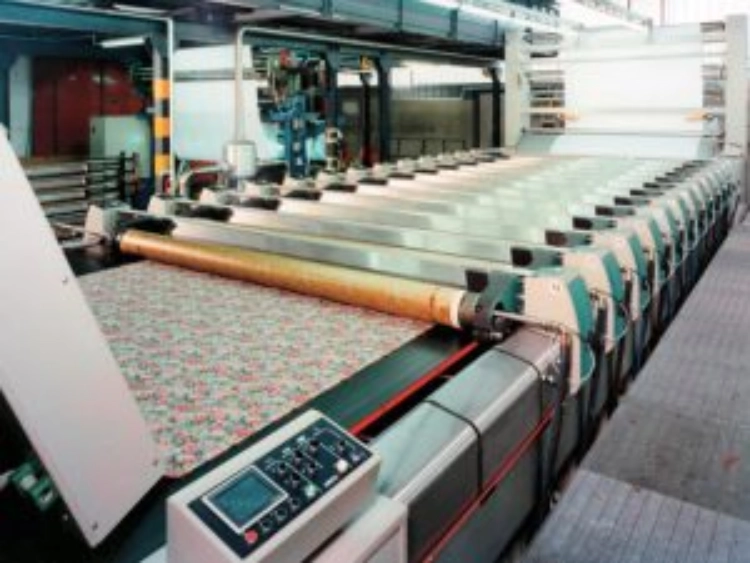
What heat, dye and solvent actually demand from a printing belt: a cover that stays flat through repeated hot and wet cycles, releases dye paste cleanly instead of holding it, and shrugs off the months-long softening that solvent inks cause. Miss any of the three and the symptoms surface as register drift, repeat marks down the cloth or lint build-up — almost never as an obvious belt failure, which is why the wrong belt usually gets blamed on something else.
Three printing lines this year, three calls about a belt. Every one of them turned out to be the dryer.
Register drifting late in the shift. A smell off the cover nobody wants to explain to a customer. A band repeating down the cloth at regular intervals. Change the belt, and the band is back before the next season.
What the Dryer Does
Hot in the tunnel. Cool on the return. Wet at the wash. Hot again. Four hundred times a shift on a quick machine.
A decent cover takes that for a year or more. The wrong one takes a permanent set inside a month, and after that you are chasing register with the tension screw. That is a fight you lose slowly and then all at once.
Here is the part that gets missed. A cover does not have to crack to be finished. It only has to stop lying flat.
Dye Paste Doesn’t Come Off Textured Covers
Paste is thickener, binder and dye. After fixation a film of it stays behind. A scraper takes that film off a smooth cover in one pass. On a textured cover it sits in the valleys and bakes solid on the next trip through the dryer.
Then squeegee pressure goes up to compensate. Screens wear out faster. Print quality drops. The screens get blamed, and the screens were fine.
Shops running reactive dyes with a wash between lots know where the money goes. Cleaning and screens. Not belts. A cover that releases paste cleanly pays for itself in screen budget alone.
Solvent Works Slowly
Solvent inks and wipe-down agents do not kill a belt in a week. They soften the cover over months until it feels tacky. Tacky belts collect lint. Lint is a defect. By the time anyone connects the two, the cover has been dragging lint for a month and the fabric supplier has taken the blame for all of it.
Six Properties, One That Bites
Our list for this industry reads: wear resistance, heat and humidity resistance, chemical resistance, straight running, positioning with repeat accuracy, flat and smooth surface. Six lines, and the textile and printing range is built to them. One of the six will be the reason a belt comes off early. It is almost always straight running.
Register lives at the splice
The splice — the joint where the two ends of a belt meet, welded or clipped — is where print register lives. A belt can wander two millimetres at the drum and still print in the same place each revolution, so long as the join is square. Clip joints are not square. Endless belts welded in a press can be. Ask what the splice tolerance is. A shrug counts as an answer.
Measure the join, not the middle
Buyers gauge the middle of a roll and argue over decimals. Measure the join. A step there lifts the fabric, the squeegee digs in, and the defect repeats once per belt length. One plant went through four belts over a single bad splice. Four invoices, one join, nobody looked.
If you cut and weld in house, the press and the ply separator deserve as much attention as the belt. A ragged ply line makes a lumpy splice, and a lumpy splice makes exactly the band you were trying to cure. There is a write-up on ply separation here if the workshop wants the detail.
Chemical resistance is a test, not a claim
Which dye class. Which solvent. Which wash chemical, at what strength, at what temperature. Two printers with identical machines and different chemistry need different covers. No datasheet settles that. A strip of sample left in the real wash tank for a fortnight will — and if the strip comes out swollen, tacky or discoloured, that result outweighs anything printed on a datasheet and changes the recommendation, including away from a polymer you were already running.
Right Belt, Wrong Station
A textile plant does not need one belt. It needs three or four, and a single specification for the whole works always means overpaying somewhere.
Printing tables and blankets
Thin, smooth, dimensionally stable. PU belting — polyurethane, a thermoplastic cover that keeps its length and shape through hot, wet cycles — holds its length through a wet-heat cycle better than most, which is the whole job on a positioning table.
Dryer runs
Heat and humidity matter here, precision does not. PVC earns its place on those runs at a lower cost per metre, provided the dye chemistry leaves the plasticiser alone.
Wet finishing
Water, steam and dye together. This is where a belt with no fabric inside starts to make sense, and a homogeneous belt — moulded from a single material, with no fabric plies to absorb water — is a different purchase from a laminated one rather than a fancier version of it.
Batching and heavy rolls
Nobody needs precision at a batcher. They need tensile strength and a join that survives the pull, which is solid woven PVK — polyester fibres woven into a single dense carcass, with no coating to lift or separate — territory.
| Station | What the belt must survive | Construction that fits |
| Printing tables and blankets | Wet-heat cycles without length change | PU |
| Dryer runs | Heat and humidity; precision not critical | PVC, where dye chemistry leaves the plasticiser alone |
| Wet finishing | Constant water, steam and dye | Homogeneous, no fabric to wick |
| Batching and heavy rolls | High tension and a join that holds | Solid woven PVK |
Guide Welding, and Other Things Nobody Asks
Width tolerance. Edge finish. Which face carries the guide. Get the last of those wrong and a perfectly good belt becomes scrap in an afternoon, usually during a shutdown, usually with no spare in the building.
About UYANG BELTING
Tianjin UYANG BELTING. Twenty years of light conveyor belts. 80,000 square metres, fifteen production lines, PVC, PU and PVK, plus the presses, separators and welders that go round them. Textile and printing is one of the named industries there. Standard orders leave in seven to twenty days, warranty runs twelve months from the bill of lading, and the technical line stays open after that.
Before You Send the PO
Name the machine, not the belt. Name the dye class and the wash chemistry. State the splice and the flatness you will accept. Confirm running direction and which face takes the guide. Soak a sample. Buy the spare with the running belt. These things never fail at a convenient hour, and the one week you cannot afford a stop is the week it happens.
None of that is complicated, and none of it is optional. The plants that rarely call about belts are not the ones buying better belts; they are the ones who specified the join, the flatness and the chemistry before the first order went out. Spend that effort up front and the belt becomes the least interesting part of the line, which is exactly where it belongs.
FAQ
Q1: Will a plain PVC belt do for textile printing?
A1: On the dryer run, often yes. At the print position, no. You need a cover that stays flat through heat cycles, and a standard PVC cover is the one that takes a set.
Q2: How do you know the splice is causing the defect?
A2: The defect repeats at belt length. Not randomly. Run a straight edge across the join and you will usually see why.
Q3: Does humidity matter as much as temperature?
A3: In a wet finishing hall it matters more. A cover that swells takes a set, and a cover with a set tracks badly on the way back through the machine.
Q4: Homogeneous or laminate for printing?
A4: Homogeneous where water and dye are constant. Laminate PU where the work is dry and precise. The price gap buys different things.
Q5: How long should a printing belt last?
A5: Two years on a clean dry line. Six months where heat and solvent both live. Six months on a dry line means tension or pulley size, not belt quality.